
Dr. Asyikeen Azhar
Co-founder & Chief Tech

The generative AI (GenAI) model is only one part of the system.
“AI-powered” is becoming one of the least useful ways to describe a product. firstly, most people mean GenAI models (e.g Claude, GPT, Deepseek) when they use the term AI. secondly, GenAI models have been conflated to mean AI but actually artifical intelligence in the computer science world is a an overarching term for systems that mimic tasks that typically requires human reasoning and intelligence. thirdly, two social media tools can use the same underlying GenAI models and do completely different things. one may write captions, another generates finished creative, another looks for emerging trends, while another helps decide what a brand should create next. From a computer science perspective, that distinction matters much more than just which GenAI model sits underneath the interface.
when I look at an "AI" social media tool, my first question is rarely: "Which model does it use?"
it is: "What decision is this system actually designed to make?"
because the model is not the product; the system - or in more scientific terms, the algorithmic framework - around it is.
in the computer science world, algorithms can be catgeorised according to how they solve problems and how they improve across time. they can be further broken down into approximation algorithms (e.g heuristic & metaheuristics), learning & adaptive algorithms (e.g supervised learning, unsupervised learning, reinforcement learning), and exact algorithms (e.g. greedy, dynamic programming, brute force, divide and conquer). so instead, let's ask HOW the GenAI model is being used.
---
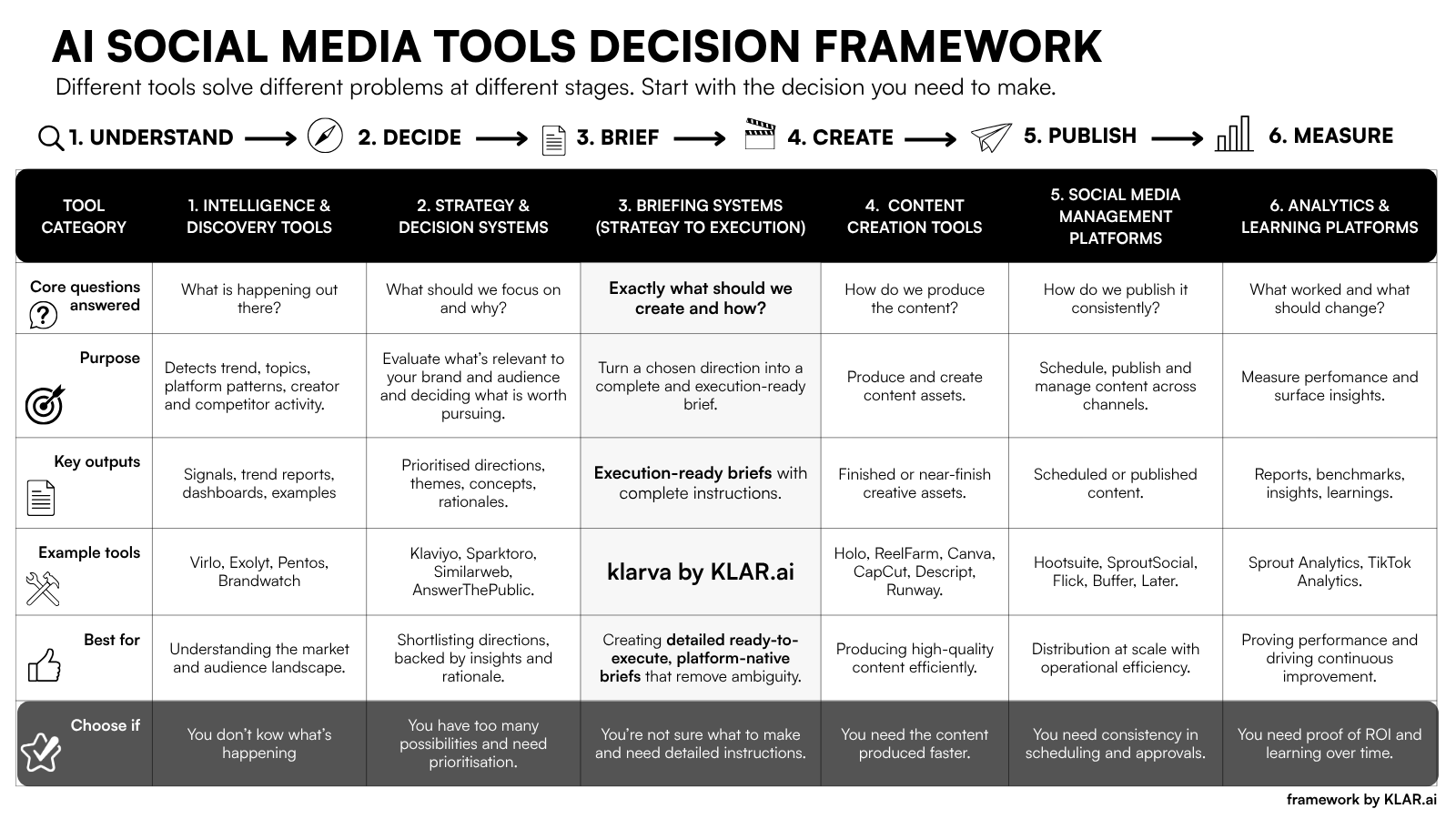
from diagram above, a breakdown of the social media process is: UNDERSTAND → DECIDE → BRIEF → CREATE → PUBLISH → MEASURE. the point of this framework is simple: products carrying the same “AI social media tool” label can sit at completely different points in the workflow. the tools can help you understand what is happening, decide what to do, generate the asset, or help publish and measure it. klarva sits primarily across decision and briefing: helping determine what is worth creating, then translating that direction into a sufficiently detailed brief that a team can move into recording, editing and publishing.
the rest of this article explains why I think this distinction matters.
---
a useful way to think about this comes from classical algorithm design. In "Introduction to Algorithms" (Cormen, T. H., Leiserson, C. E., Rivest, R. L., & Stein, C., 2022), an algorithm is fundamentally a procedure for taking some input and producing an output that solves a defined computational problem. the interesting part is not any single operation inside that procedure. it is how the overall problem is defined and how the sequence of operations is designed to solve it. this distinction matters when we talk about GenAI products.
a GenAI model can be extremely capable while still being only one subroutine inside a larger piece of software. the same model might be used to summarise a document, generate an image description, classify an observation, propose possible solutions or translate an already-made decision into natural language. the underlying model may be identical, but the computational problem surrounding it is not.
let's take one of the canonical problems in algorithms: sorting. two algorithms, quicksort and merge sort, ultimately solve the same problem of putting elements into order, but they approach that problem differently and make different trade-offs around time, memory and behaviour under different inputs. now, let's reverse that idea. we can take the same computational component to be reused inside completely different problems. what matters is:
this is why products built on the same Claude, GPT or DeepSeek GenAI model can be fundamentally different. they may use a GenAI model primarily to generate, interpret, evaluate, or help translate a decision made elsewhere in the system into something a human can understand and act on. from the outside, all four products may carry the same “AI-powered” label. yet from a computer science perspective, they are solving different problems. this is also where concepts such as exact algorithms, approximation methods and learning algorithms become useful ways of thinking about AI products.
some problems have clearly defined rules and solutions. meanwhile, others may involve enormous search spaces where finding the theoretically optimal answer may be impractical, so an acceptable or near-optimal solution is more useful. others involve systems that adapt as they observe more data. therefore, the design question is not simply, "How intelligent is the GenAI model?". because one may just simply swap a model to another and pay for the cost difference. rather, we should ask: "What role has the GenAI model been assigned within the larger problem-solving framework?" this question tells us far more about what an AI social media tool actually does.
---
if the GenAI model is only a subroutine, then the more useful way to compare AI social media tools is by looking at the larger computational problem around it. for each product, I would ask three things: What goes in → what problem is being solved → what comes out
based on that framing, I would group most AI social media tools into five broad categories. these categories are not mutually exclusive as many products can span more than one, but they help identify the primary problem the system is designed to solve.
the simplest case looks roughly like: Prompt + supplied context → GenAI model → response
the user defines both the problem and much of the information or context required to solve it. for example, "Give me ten TikTok ideas for a sustainable fashion brand." the model can return ten perfectly plausible ideas. this is useful, but notice where most of the decision-making still sits. the user decides what information belongs in the prompt, what is relevant, whether the output makes sense for the brand, and, ultimately, which of those ten possibilities is worth producing.
the primary problem being solved is therefore something like: "Given these instructions and this context, produce a useful response." that is not necessarily the same problem as: "Given everything relevant to this brand, what should it prioritise?" general-purpose assistants are powerful precisely because they are general, but that also means much of the problem definition remains with the person using them.
---
content-generation systems solve a more specific problem: Brand or creative inputs → generation → finished or near-finished content
here, the desired output is not primarily a decision; it is an asset. that could be:
Holo is a useful example. it takes information about a business, builds what it calls a “Brand DNA”, and uses that context to generate marketing assets that can be edited and published. the computational objective is closer to: "Given what we know about this brand and the requested creative task, produce content that satisfies those conditions." this solves a genuine bottleneck of: "We know we need content. Help us produce it faster."
in computer science terms, the emphasis is largely on generation under a set of inputs and constraints. the difficult question is therefore not necessarily whether something should be created. that decision may already have been made; the system's job is to just help create it.
---
a third category starts from a different problem altogether: Existing social workflow + account data + content → AI assistance → easier management
here, AI is incorporated into a broader operational system. It might help:
platforms such as Hootsuite increasingly span several of these functions. the important distinction is that the broader system already has a primary job that is to manage social media activity. AI becomes a subroutine that makes parts of that workflow faster, easier or more intelligent. if your bottleneck is publishing, approvals, engagement, reporting or managing several channels, this is a sensible place to apply AI. however, those are predominantly operational problems. a different problem happens before operations begin: "What is actually worth making?"
---
now consider systems where the primary input is not a creative brief but large amounts of platform or market data: Platform data → analysis → signals and insights
their purpose is principally observational. They may analyse:
Virlo, for example, sits much closer to this category: its value is in surfacing what is gaining traction across short-form video and making those signals easier to use during ideation. the problem being solved is on "what is happening in the environment?"
this is an intelligence problem and intelligence is useful because good decisions require good information. nevertheless, information and decisions are not interchangeable. a trend can be real and still be irrelevant to your brand, a competitor's format can perform exceptionally well and still be wrong for your audience, and a creator can reveal an emerging behaviour without telling you how your brand should respond to it. so the output of an intelligence system is primarily evidence. unfortunately, what you do with that evidence is another problem. data tells us what is happening whereas strategy decides what is worth acting on.
---
the fifth category shifts the computational problem again. instead of asking what can we generate, or what is happening, the question then becomes: "Given the information available, what should we prioritise?" this starts to resemble a classical recommendation or decision-support problem. the challenge is not that there are too few possible things a brand could create. usually, the opposite is true. there may be hundreds of plausible topics, trends, formats, angles and ideas competing for a limited amount of time, budget and attention. the problem therefore becomes one of selection under constraints.
a useful strategy system should help reduce that large possibility space into a smaller set of directions that are relevant enough to act on. importantly, the useful output does not have to stop at just giving you an idea. a strategy recommendation can be translated into something much closer to an executable plan: what the concept is, what format it should take, why it is relevant and what someone needs in order to actually produce it. the problem being solved is therefore closer to: "Given the available information and objectives, which direction is worth pursuing and how do we make that decision actionable?"
this distinction matters. generating one hundred ideas is largely a problem of abundance whereas selecting a handful that deserve a team's limited creative resources is a problem of prioritisation. furthermore, turning those decisions into sufficiently detailed instructions that a team can move into production is yet another part of reducing uncertainty between strategy and execution. this is why I find recommendation and strategy systems particularly interesting from a computer science perspective. they bring us back to the concepts introduced earlier: objectives, constraints, approximation and adaptation.
in many real-world strategy problems, there is no single mathematically provable “best TikTok post”. the search space is enormous, the environment changes continuously and several competing objectives may matter at once. the system therefore does not need to solve the abstract question: "What is the perfect piece of content?" it needs to solve the much more useful one: "Given what we know now, what is a sufficiently good decision to make next?" that is a very different computational problem from simply asking a GenAI model to create more content.
---
the point of these five categories is not to establish a hierarchy. a content generator is not inherently less sophisticated than a recommendation system. a social management platform is not inherently more useful than an intelligence tool. they are merely solving different classes of problems. so before comparing which AI social media tool has the longest feature list, I would first ask: "What problem are we actually trying to solve?" only then does it make sense to ask what role GenAI plays in solving it. additionally, two things commonly marketed as evidence of “strategy” - brand awareness and real-time data - deserve a closer look.
---
a lot of AI products now say they “understand your brand”. usually, this means the system has access to information such as your website, products, audience, tone of voice, previous content or brand guidelines. This is useful as more relevant information should, in principle, give the system a better representation of the problem than a generic prompt with no context at all. however, from a computer science perspective, we should be precise about what has changed.
brand context changes the input to the problem. it does not, by itself, define how the problem should be solved. for example, are these two requests: "Write a TikTok caption in our brand voice" and "Give us ten TikTok ideas based on our website". both are brand-aware tasks. the model has been given additional information that constrains or conditions what it generates, but the underlying objective remains largely predetermined by the user which is to generate a caption or to generate ten ideas.
the system has not necessarily decided whether a caption is what the brand needs, whether those ten ideas are equally relevant, or which one is most worth spending time and money producing. this brings us back to a basic distinction in optimisation. having more information about a problem does not tell you what constitutes a better solution. to choose between possible solutions, some objective must exist. in a simple optimisation problem, we might define an objective function and ask an algorithm to minimise cost, maximise utility or find the shortest path subject to a set of constraints.
alas, real-world social media strategy is considerably messier because there is rarely one objective that can be expressed neatly as a single number. a team may care simultaneously about audience relevance, brand fit, business objectives, timeliness, creative feasibility and differentiation from what it has already published. unfortunately, these considerations can also conflict. the most timely idea may not fit the brand, the most on-brand idea may not be particularly relevant to what the audience cares about now and the format receiving the strongest platform signal may require resources the team does not have. so there is an important difference between "Generate something consistent with this brand" and "Given the available possibilities, determine which direction is sufficiently relevant to this brand, its audience, its objectives and its constraints to justify pursuing".
the first is primarily a conditional generation problem whereas the second is a decision problem. once there are multiple possible actions competing against objectives and constraints, we have moved into the territory of optimisation, approximation and decision-making. this is why “it knows your brand” is useful information when evaluating an AI product, but it is not enough to tell us whether that product is performing strategy. brand context tells the system more about who you are. on the other hand, strategy requires some mechanism for deciding what you should do with that information.
---
the same distinction applies to platform data. more data does not automatically produce better decisions. in computer science and data science, the value of an input depends not only on how much of it we have, but on whether it is relevant to the problem we are trying to solve. a system could ingest millions of TikTok videos and still make poor recommendations if it cannot separate useful signals from noise. this is partly a selection problem.
the raw platform may contain many observations, but only a subset may matter for a particular brand, audience or objective. the challenge is therefore not simply to collect more data, but to decide which observations deserve computational attention in the first place. that immediately raises harder questions:
these are not merely data-collection questions. they are questions about relevance, bias, generalisation and decision quality. giving an algorithm more input can increase the amount of information available, but it can also increase the size of the search space and the computational effort required to find a useful solution. more data is only helpful if the system can make meaningful distinctions within it. otherwise, it becomes more noise.
this is why “real-time data” sounds more impressive than it necessarily is. freshness is only one property of a signal. a very recent observation can still be irrelevant, a highly engaging post can still be misleading, a repeated pattern can still fail to generalise, and a trend can still be completely wrong for a particular brand. so the real question is not, "How much platform data does the system have?" it is, "How does the system determine which parts of that data are useful for the decision it is trying to make?"
this is where conversations about AI products often become too model-centric. we spend enormous amounts of time debating whether Model A is better than Model B, while many of the harder product decisions sit outside the GenAI model entirely.
those choices shape the behaviour of the system before a GenAI model ever produces a sentence. real-time data can tell us more about what is happening now. meanwhile, strategy still requires deciding which of those signals should matter, and what to do about them.
---
we now have enough of a framework to turn the theory into something practical. at this point, I would stop looking at feature lists and start looking at the system itself. most product pages will tell you what the tool can do. far fewer tell you how the tool is making decisions. these are the five questions I would ask.
start with the inputs: does the system only know what you type into a prompt? does it have access to your:
the quality of any output is bounded by what the system can observe; a sophisticated model with poor or irrelevant inputs can still produce weak decisions. so when a product says it is “brand-aware” or “real-time”, I would ask what that actually means in practice. what information is available to the system when it makes a decision?
---
the first thing to clarify is the objective. are you trying to:
these are not different features of the same problem, they are different computational problems. a system optimised for generating large volumes of creative does not automatically become good at prioritising what should be created. a strong analytics system does not automatically become a strategy system. so before asking whether a tool is “good”, ask: "Good at solving what?"
---
if the GenAI model is only a subroutine, then what matters is the larger framework around it. is the product essentially: context → prompt → model → answer
or is there a broader process that helps structure the decision before or after the model is used? you do not necessarily need to know the proprietary implementation. but, you should be able to understand, at a high level, whether the product has been designed around a specific problem or whether the GenAI model is being asked to carry most of the reasoning by itself. the more consequential the decision, the less useful it is to treat the foundation model as the entire system.
---
a model response and a product recommendation are not necessarily the same thing. that distinction matters because GenAI models are probabilistic. they can produce fluent, plausible responses that still fail the actual objective of the product. so I would ask: "Does the system simply show me what the model generated, or does the product do something meaningful with that output before I see it?" that question tells you a great deal about whether the AI has been added as a feature or designed as part of a broader decision process.
---
this is probably one of the most overused words in AI product marketing. a tool might say it “learns your preferences”, but that can describe very different mechanisms. it might:
those are not equivalent. in learning and adaptive algorithms, new observations should have some defined effect on future behaviour. so if a product claims to learn, I would ask: "What user action is treated as feedback, and what specifically changes because of it?" In abstract terms: observation → update → different future behaviour. if there is no meaningful relationship between those three steps, then “learning” may just be another marketing label.
---
these five questions bring us back to the framework at the beginning. instead of asking which model does this tool use or how many AI features does it have, I would ask: "What does the system know, what problem is it solving, how is the model used, how are outputs handled, and what changes over time?" those questions tell you much more about whether two “AI social media tools” are actually comparable at all. now we can locate klarva within that framework.
---
klarva is not intended to be a finished-content generator, and it is not another social media scheduler. the problem we wanted to solve happens earlier: "What should this brand create on TikTok next?"
that means the useful output is not simply more ideas. a team still has to turn an idea into something they can actually make: decide the format, shape the hook, plan the shots, write the caption, think through text overlays and work out how the post should come together. so klarva sits across the decide and brief stages of the framework shown earlier. it combines brand and audience context with near-real-time TikTok signals, then turns relevant directions into detailed, execution-ready content briefs. each brief translates the strategic decision into practical instructions covering the concept, format, rationale, hook, shot list, caption, text overlays, sound direction and recommended posting window. the intent is to remove much of the work between deciding what might be worth doing and knowing what to record.
the GenAI model is part of that system; it is NOT the system. that distinction matters because the objective is not to maximise the number of possible ideas. GenAI models are already very good at producing abundance. the harder problem is reducing a large possibility space into a smaller set of directions that are relevant enough to deserve a team's limited time and creative resources, then making those directions concrete enough to execute.
the team still makes the final creative decision, and that is intentional. when a brief is discarded, that decision also becomes feedback for future recommendations. for now, discards is the learning signal klarva uses: they tell the system something about what the team does not want to pursue. so the role of the system is not to replace the strategist, creator or social media manager. it is to do more of the research, computational and planning heavy lifting before they pick up the camera.
---
return to the diagram above - start with the bottleneck, not the model.
if the blank page is your problem:
use a general-purpose GenAI assistant or content-generation tool.
if producing enough creative is your problem:
use an AI creative-production platform.
if publishing, approvals and day-to-day management are your problem:
use social media management software with AI embedded into the workflow.
if your problem is understanding what is happening across your category or platform:
use social listening, analytics or trend-intelligence tools.
if you already have people who can create content, but the harder question is what is actually worth creating:
look at strategy and recommendation systems.
none of these categories is inherently more intelligent, more sophisticated or more useful than another. they are just optimised for different problems. that's the point! the label “AI social media tool” collapses several fundamentally different systems into one category, when the more meaningful differences sit underneath the interface: the inputs available to the system, the problem being solved, the objective being optimised, the constraints that matter, the role of the GenAI model and what the final output is supposed to help a human do.
so I would not choose a tool based on which company claims to have the “best AI”. foundation models will continue to improve, and products can change the models they use. instead, the more durable question is: "What problem has this product actually been designed to solve?" once that is clear, it becomes much easier to judge whether the AI is doing something meaningful or simply generating another answer.
Strategy without systems doesn’t scale. Systems without strategy don’t make sense.
We build, and think, at the intersection.