Dr. Asyikeen Azhar
Co-founder & Chief Tech

A data scientist's perspective on why this happens, and what actually makes AI recommendations more useful.

If you ask an AI tool to generate ten TikTok ideas for a skincare brand, you'll probably get something along these lines:
- Five skincare mistakes you're making
- A day in the life of our team
- Behind the scenes of our products
- Three tips for healthier skin
- Myth vs fact: Skincare edition
If you replace "skincare" with "coffee", "fitness" or "fashion", most of those ideas would still work. Therein lies the problem. The AI hasn't necessarily produced anything incorrect as these are perfectly plausible content suggestions. However, they're so broadly applicable that they tell us very little about what makes a particular brand different.
Caveat: I'm a data scientist, not a content creator. My background is in designing algorithms, and more recently, building AI systems for social media teams. From that angle, I'm interested in breaking down why AI models can be capable of producing sophisticated writing, code and analysis and yet produce predictable content ideas. Therefore, how then can those everyday recommndations, not just one-off, be genuinely useful.
We begin with how large language models (LLMs) work. At a simplified level, an LLM generates text by predicting likely continuations based on patterns learned during training and the context it receives, just like how other machine learning models work. Modern models can perform surprisingly complex reasoning, but their ability to produce convincing language doesn't automatically mean they're making a good strategic decision.
For the prompt "Give me ten TikTok ideas for a skincare brand", the model has very little information to work with. It doesn't know which audience the brand is targeting, what the brand has already published, which conversations matter to its customers or what the team is trying to achieve. So it draws on widely recognisable patterns associated with skincare content and TikTok. All of these can be plausible content: educational tips, behind-the-scenes, or myth-busting. None of them are inherently bad ideas, but the model has little basis for deciding why one would be particularly appropriate for this brand right now. Therefore, plausibility doesn't equate to usefulness. This distinction matters when evaluating any AI product as a response can be fluent, polished and entirely reasonable while still failing to solve the user's actual problem.
This isn't just a subjective complaint about AI-generated content as researchers have investigated whether generative AI increases creativity or makes creative outputs more similar. The 2024 study published in Science Advances found that participants who received AI-generated story ideas produced stories that were rated as more creative, better written and more enjoyable, particularly among less creative writers. However, there's a catch. The AI-assisted stories were also more similar to one another than those produced without AI assistance. In other words, AI helped individuals produce stronger creative work in the experiment, while reducing the diversity of outputs across the group.
Similarly, a 2025 study published in PNAS found recurring combinations of plot elements in LLM-generated stories, even across different generations.
These studies focused on storytelling, not TikTok marketing so we shouldn't assume the findings translate directly into social media performance. Even so, they illustrate a problem relevant to AI-assisted ideation: a system can produce individually convincing outputs without generating much diversity across those outputs.
You can imagine thousands of brands asking similar AI tools for content ideas. If those tools operate with similar instructions and limited context, it's reasonable to be concerned about how much their suggestions might converge. Furthermore, generating ten variations of the same familiar concept doesn't necessarily solve that problem.
One common suggestion is to improve the prompt. Instead of asking for TikTok ideas for a skincare brand, you might provide its website, target audience, positioning, tone of voice and products. That's certainly better than giving the model almost nothing. In machine learning, we would call this providing additional context or conditioning information. However, there's another distinction I think is often overlooked: knowing more about a brand doesn't automatically mean knowing what to recommend.
Let's suppose an AI system understands that your brand sells premium, environmentally conscious skincare products. It might now generate five sustainable skincare tips for environmentally conscious consumers that is more aligned with the brand description. Even so, it's essentially the same generic idea, adapted with relevant adjectives. The system has demonstrated that it can incorporate brand information into its output and yet, it hasn't necessarily demonstrated that it can identify a distinctive creative opportunity.
This is similar to the distinction between data and decisions in optimisation. More information can improve our understanding of a problem, but information alone doesn't define what makes one solution preferable to another. To make a useful recommendation, we also need to consider the objective, available options, relevant evidence and constraints. Although brand context is an important input, it's not the entire decision-making process.
This is where my background in algorithm design becomes particularly relevant. Even though an AI model generating 100 possible TikTok concepts may be impressive from a generation perspective, the crucial question is what happens next. A social media team still needs to determine which concepts are relevant, which are sufficiently different from existing content, which have supporting evidence and which deserve limited production resources.
Crucially, we've moved from a generation problem to a selection problem and this distinction is fundamental. A generation system may ask what are some possible answers whereas a recommendation system must focus on certain possibilites that are worth considering most given the information and constraints present. A system can be excellent at the former, but relatively weak at the latter and simply increasing the number of generated ideas doesn't solve the selection problem. Ironically, it might make matters worse by creating more possibilities for someone to review. This is one reason I find intelligence and decision-support systems more interesting than pure automation. Using the latter, producing more output is useful when production is the bottleneck. Using the former, more output isn't necessarily the answer when the bottleneck is deciding what deserves attention.
There's no magical single prompt or setting that guarantees original, relevant creative ideas. However, I would look at four things from a systems-design perspective.
An AI system should have access to information that meaningfully distinguishes one brand's situation from another. For example, a statement like "our brand is friendly and authentic" offers relatively little differentiation. Information about a particular audience, product constraint, business objective or previously rejected direction can be much more consequential. Furthermore, context needs to be accurate and relevant. Adding enormous amounts of brand documentation isn't automatically better if the system cannot distinguish important information from noise. Hence, the quality and usefulness of information for the AI when making a decision matters more than the quantity of information it receives.
An LLM can invent ten plausible TikTok ideas without observing a single current TikTok video. Generating these ideas can be useful for brainstorming, but if a product claims to identify current creative opportunities, I'd want to know what evidence supports its recommendations. All of these are different sources of information: an observable platform activity, a recurring audience conversation, an existing content pattern or simply what the model considers a plausible idea from the data it was trained with. They shouldn't be presented as though they carry equal weight. Importantly, having access to real-time data isn't sufficient either. The system still needs to determine which observations are relevant, reliable and worth considering. A useful AI recommendation should make it easier to understand the evidence behind an idea, not just present the conclusion confidently.
An AI model can produce these three ideas that are technically different sentences and yet similar conceptually:
1. Five common mistakes beginners make
2. Three mistakes you should avoid
3. The biggest mistakes nobody talks about
This illustrates an important difference between linguistic diversity and idea diversity. Changing the wording, hook or number of items doesn't necessarily produce a different creative concept. An AI system intended to support ideation should be evaluated on whether its suggestions represent meaningfully different possibilities, not just variations in phrasing. That doesn't mean every recommendation needs to be radically original; familiar formats can be useful too. The point is that a system should distinguish between deliberate variation and superficial rewording.
Perhaps the most important limitation is that AI doesn't automatically have access to everything a social media professional knows. A recommendation may appear relevant based on the available data, but the person reviewing it might know that it conflicts with an upcoming campaign, repeats a recently published idea or simply isn't suitable for the brand. That judgement is gold. An AI product should allow people to reject, revise and challenge its suggestions. I'd also want to understand what happens to that feedback, whether a rejected idea simply disappear, is the preference remembered or smething changes in subsequent recommendations. These possibilities are not equivalent and a thumbs-down button alone doesn't mean a system is learning. The important question is whether feedback can meaningfully influence future behaviour, rather than becoming another piece of unused data.
If you're evaluating an AI ideation tool, here's one test I'd suggest: take several generated ideas and remove the brand name. If they be recommended, almost unchanged, to dozens of other brands in the same industry, the system may be producing category-level suggestions rather than genuinely brand-specific ones. I call this the brand-swap test. Although it's not a scientifically validated evaluation metric, and passing it doesn't guarantee creative quality, it's still a useful diagnostic question. You can go further by asking (1) what information makes this recommendation specific to your brand, (2) what evidence supports it, (3) how is it different from the other suggestions, (4) what assumptions is the AI making and (5) can we explain why this idea was recommended over another. Notice that none of these questions requires knowing how to build an AI model. They simply help distinguish a convincing-looking response from one that's supported by a meaningful decision process. Ultimately, the creative team still determines whether the direction is worth pursuing.
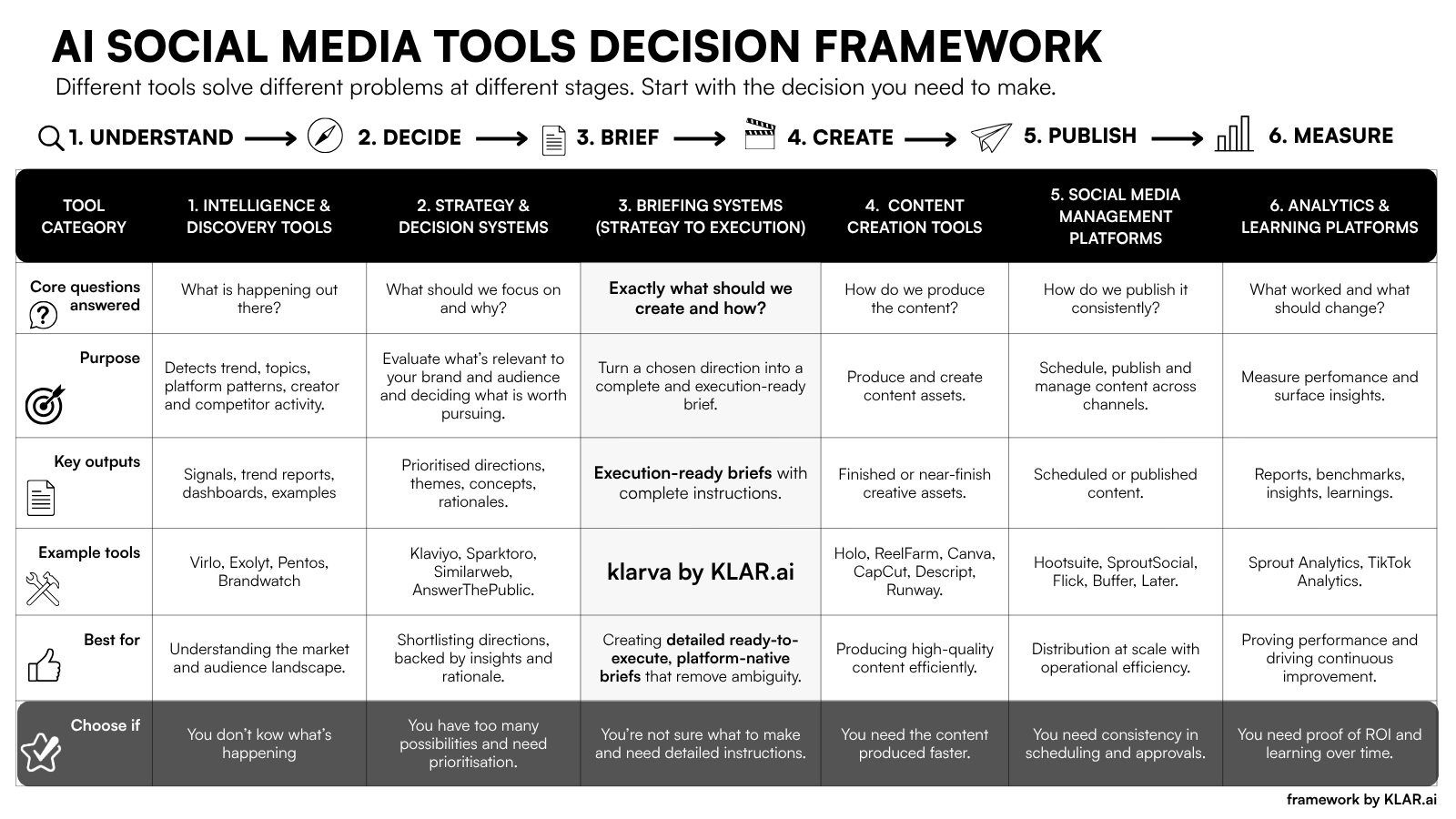
This is one of the questions that motivated us to build klarva at KLAR.ai. We weren't interested in creating another tool that simply generates an endless list of TikTok ideas. As I've exemplified, generative AI models are already remarkably capable at producing suggestions. The problem we're interested in comes earlier: identifying opportunities that are relevant to a particular brand, then translating those directions into useful briefs for the people who actually create the content. That's why klarva focuses on combining brand and audience context with current TikTok signals, rather than treating content ideation as an isolated text-generation task. Additionally, acknowledging that AI recommendations will never be perfectly informed is key. There will always be context the system doesn't have, judgement that is difficult to express computationally and situations where the creative team knows better. Truly, the goal isn't to make AI the creative director. It's to build better decision-support technology that helps creative professionals spend less time sorting through possibilities and more time on the work that requires their expertise.
When people describe AI-generated content as generic, it's tempting to think the solution is simply a more powerful model or a cleverer prompt. The problem is often more fundamental although those might help. In actuality, the system may be answering a different question from the one its user actually needs answered. Generating ten plausible ideas is not the same as identifying a few relevant, differentiated opportunities and producing an impressive response is not the same as making a useful recommendation. As a data scientist, that's the distinction I keep coming back to. To me, the interesting challenge is getting AI to make better distinctions between ideas, not just producing more of them.
---
Dr. Asyikeen Azhar is the Co-founder and CTO of KLAR.ai. She holds an Engineering Doctorate in Computer Science and has a background in applied data science, machine learning and optimisation.
Strategy without systems doesn’t scale. Systems without strategy don’t make sense.
We build, and think, at the intersection.