Dr. Asyikeen Azhar
Co-founder & Chief Tech

Popularity is easy to measure, but relevance is much harder. Here's what building an AI TikTok Strategist has taught me about the difference.

Imagine an AI social media tool recommending a TikTok video to a brand because it has two million views. Sounds reasonable, right? Now imagine another video with 80,000 views that is far more relevant to the brand's audience and positioning. Now, which video should the tool recommend? From an engineering perspective, this is an interesting problem. While the first video has a much larger observable number, that number alone tells us surprisingly little about whether it's a useful recommendation.
To caveat, I'm a data scientist by training, not a social media manager. My expertise is in building and evaluating algorithms, rather than deciding what makes great creative content. But building klarva, our AI TikTok strategist, has made me think a lot about how easily algorithms can mistake what's measurable for what's meaningful and why access to more data doesn't necessarily produce better recommendations.
Machine learning systems depend on signals. A signal is an observable piece of information that may help us make a prediction or decision. On TikTok, those signals might include views, likes, comments, posting dates or characteristics of the video itself. The difficulty is deciding what those signals actually tell us. For example, take view counts. A video with two million views has clearly reached a substantial audience. However, those views could be influenced by numerous factors, including the creator's existing reach, the subject, timing and distribution. We cannot automatically conclude that the creative format caused its popularity.
In statistics, this is related to confounding variables: factors that can influence an observed relationship and make cause and effect difficult to disentangle. An algorithm that ranks videos primarily by popularity risks confusing a successful outcome with an explanation of why that outcome occurred. That's a problem when the goal isn't simply to find popular videos, but to identify useful opportunities for a particular user.
There's another challenge when building recommendation systems from social media data. The videos we discover are not necessarily a representative sample of everything being published. For instance, search results and discovery feeds are influenced by their own ranking and retrieval mechanisms. We may see certain videos because they've already performed well or because they match the platform's search and recommendation criteria. That creates a risk of selection bias.
If our dataset consists primarily of highly visible videos, we're learning from a filtered subset of content. We might observe that a particular format appears frequently among viral videos, but without understanding the broader population of videos using that format, we cannot reliably estimate how often it succeeds. This is an important distinction - knowing what successful videos have in common is not the same as knowing what causes videos to succeed. For an AI system, the challenge is recognising those limitations rather than treating the available dataset as a complete picture of the world.
When building AI systems, there's a temptation to think that collecting more data will improve performance. Sometimes it does, but usually more data is only useful if it helps answer the question the system is trying to solve. Imagine collecting information on 10,000 popular TikTok videos. You might have an excellent dataset for identifying broadly popular content. However, suppose your actual task is recommending relevant creative opportunities for a specific consumer brand. For this, you need additional context. This can include: What audience is the brand trying to reach? Which markets does it operate in? What are its objectives? What constraints should the system respect?
Those aren't questions that view counts can answer and this is where problem formulation becomes important. In machine learning, choosing the wrong objective can produce a technically successful system that solves the wrong problem. An algorithm can become very good at identifying the most popular videos while remaining poor at identifying the videos that are useful to a particular brand. The algorithm isn't necessarily broken. It may simply be optimising for the wrong thing.
This is particularly interesting to me because my doctoral research focused on multi-objective optimisation. In many real-world problems, we're not trying to maximise a single variable. Instead, we need to balance several objectives, which may conflict with one another. For example, in production scheduling, minimising costs might conflict with minimising delivery delays or environmental impact. There may be no single solution that is best across every objective.
Recommendation systems face a related challenge. A candidate video might be highly popular but poorly aligned with a brand's context while another might be relevant but have limited evidence of broader traction. In this case, how should an algorithm compare them? A simple weighted score is one possibility, but that introduces further questions. Who determines the weights? Should they be the same for every brand? Can one strong dimension compensate for a serious weakness in another? These are system-design decisions, not universal truths, and it's dangerous to present an algorithm's ranking as objectively correct when it depends on assumptions that may not hold for every user.
One of the limitations of recommendation systems is that not everything important can be expressed through observable data. A recommendation might appear reasonable based on the available information, but a social media manager may reject it for reasons the system couldn't anticipate. Perhaps it conflicts with an upcoming campaign, or the brand has already explored a similar direction, or perhaps the creative execution simply doesn't feel appropriate. The person reviewing the recommendation has contextual knowledge that the algorithm may not possess.
From a machine learning perspective, that judgement is potentially useful feedback, but collecting a thumbs-down isn't necessarily enough. A rejection could mean the concept was irrelevant, the evidence was weak, the timing was wrong or something else entirely. Those are different problems. If an AI system treats every rejection identically, it loses potentially valuable information about why the recommendation failed. The harder engineering problem is determining how to interpret that feedback reliably, identify what the system should change and avoid learning the wrong lesson. This is an area we're actively exploring in our work on klarva.
The AI industry spends a lot of time discussing model capabilities. Which model is faster? Which has a larger context window? Which performs better on benchmarks? Those things of course matter, but they're only part of what makes an AI system useful. You can have a highly capable model working with extensive real-time data and still produce recommendations that miss the user's needs because the quality of the decision depends on more than the model itself. It depends on what information the system retrieves, how it evaluates that information, what objectives it prioritises and how it incorporates context and feedback. For social media teams evaluating AI tools, I think these are useful questions to ask of the technology. Not because social media managers need to become data scientists, but because understanding what an AI system is actually optimising for helps explain what its recommendations can and cannot tell you.
A video with two million views isn't necessarily a better recommendation than one with 80,000, but the reverse isn't automatically true either. Without sufficient context, we simply don't know. That's the part of building AI systems I find most interesting. The challenge isn't collecting as many signals as possible or generating the largest number of recommendations. It's designing systems that make useful distinctions from imperfect information, acknowledge uncertainty and leave room for human judgement.
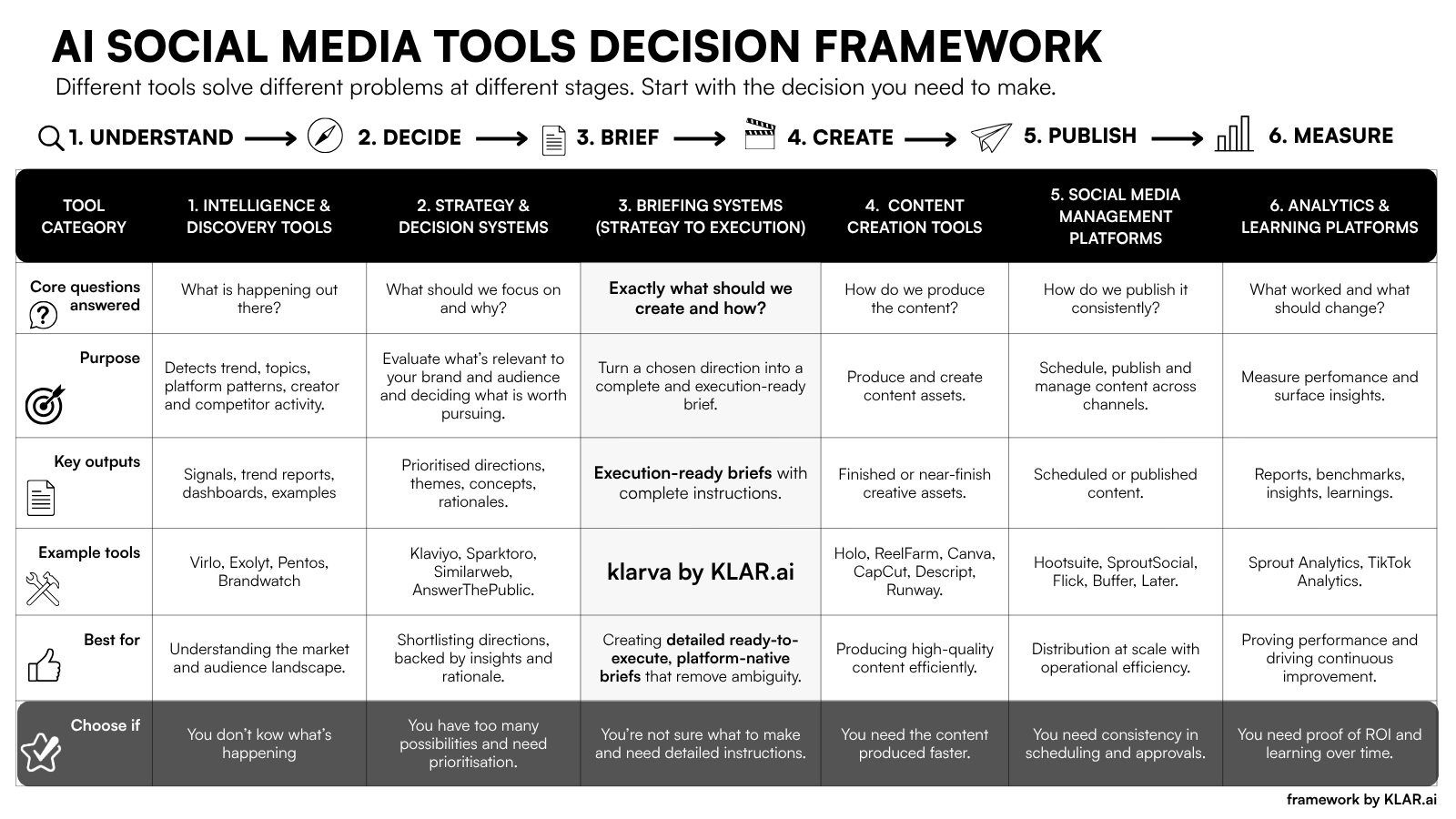
At KLAR.ai, that's the philosophy behind building klarva, our AI TikTok strategist. We're not trying to replace the judgement of social media professionals. We're building technology to support it.
Strategy without systems doesn’t scale. Systems without strategy don’t make sense.
We build, and think, at the intersection.